Showing posts with label Peter Weir. Show all posts

Thursday, October 24, 2019

GOODBYE, LENIN (2003, GERMANY), THE TRUMAN SHOW (1998)

Alex (Daniel Bruhl) and his real mother (Kathrin Sass)
in fake surroundings in Goodbye, Lenin

Goodbye, Lenin is a comedy with many dramatic elements about a young man (Alex), who during the time of the unification of Germany in the late 80's witnesses his mother (Christiane) have a near fatal heart attack and lapse into a coma. When she comes out of it a few months later, Alex tries to keep it a secret from his mother that Germany is now unified, afraid the shock might kill her. The lengths that Alex goes to keep this false narrative going reminded me of one of my favorite movies, The Truman Show.

The Truman Show is the story of Truman Burbank, an insurance salesman with a wife living a seemingly normal life in a seaside community called Seaview. Except the only thing real about Truman's life is Truman himself. All that goes on around him is part of a TV show called The Truman Show, with everyone in Truman's life being actors, all under the control of a producer named Christof.

There are a lot of similarities and a few differences in both films.
Here are ten off the top of my head.

1. Both films rely on a lot of coincidences. Goodbye, Lenin has Alex coincidentally having the nurse (Lara) of his sick mother be a woman he was separated with during a street demonstration earlier and later becoming his girlfriend. In the The Truman Show (TV show). Truman meets his future wife by her hurting her ankle and landing in his lap. This of course, was manipulated by the show's script writers.

2. The show within the movie of The  Truman Show is watched by millions of people. The special show put on for Christiane in Goodbye, Lenin is for her only.

3. The desire to become a Magellan-like explorer is a recurring theme in The Truman Show. Looking up to East German space explorer Sigmund Jahn is a recurring theme in Goodbye, Lenin.

3. Alex and Truman are both separated from their father when they are young. Both are reunited with him later, discovering the disappearances of both dads were caused by factors other than what they first thought.

4. Product placement in The Truman Show (TV show) is ubiquitous. Product placement (aka evil Western influence) in Goodbye, Lenin is something to be hidden from Christiane at all costs.

5. Alex's friend Denis utilizes old news footage and fake reports for Christiane to watch. It is amateurish, but it works. Christof the producer of The Truman Show (TV show) runs the most elaborate and expensive television show ever created.

6. Christiane finds out the truth late in Goodbye, Lenin and turns out to be okay with it. She acknowledges her love for her family before dying a couple of days later. Truman finds out the truth at the end of the movie, moons Christof and goes to the outside world.

7. You can look at The Truman Show (movie) as an indictment of capitalism (By what ratings and chasing profit makes them do to poor Truman) or of religion (The manipulative omnipresent producer is named Christof for goodness sake!) Goodbye, Lenin's politics seem to be more pro-Capitalism, (the East German stuff wasn't nearly as good as the new stuff) but that is debatable.

8. Both have fine comic moments drawn from the absurdities of their situations and make you wanna cry at other moments.

9. At the end of Goodbye, Lenin, Alex recounts that the country his mother thought she lived in never really existed the way she imagined. At the end of The Truman Show (movie), Truman realizes that the only part of the life he led that was real was himself.

10. At the end of Goodbye, Lenin, Alex's family shoots the mother's ashes into the sky and wonder whether or not she is looking down on them.  At the end of The Truman Show (movie), two of Truman's fans search for something else to watch on TV.
Truman (Jim Carrey) and his fake wife (Laura Linney)
 in fake surroundings in The Truman Show

Friday, September 20, 2019

PICNIC AT HANGING ROCK (1975, AUSTRALIA), THE CHANT OF JIMMIE BLACKSMITH (1978, AUSTRALIA), SLEEPING DOGS (1977, NEW ZEALAND), UTU (1983, NEW ZEALAND)

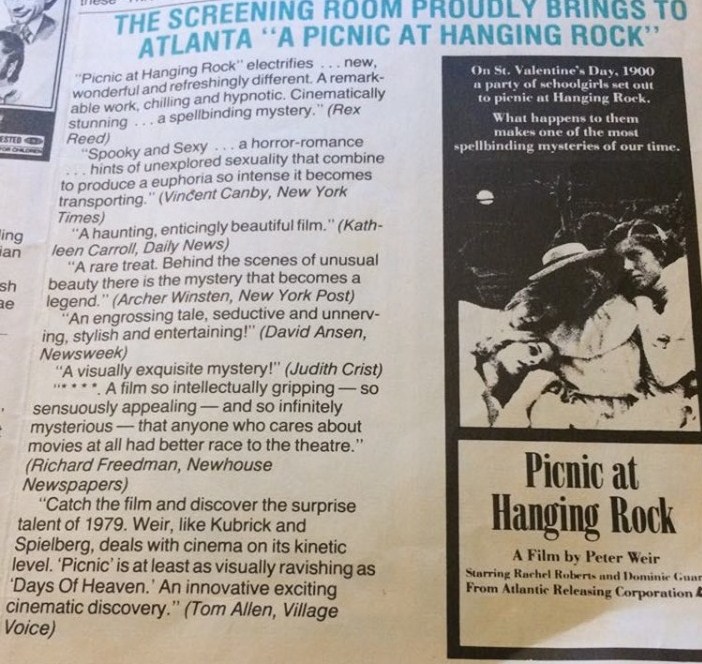
Spooky and Sexy...a horror-romance...hints of unexplored sexuality that combine to produce a euphoria so intense it becomes transporting.-Vincent Canby, The New York Times

Picnic at Hanging Rock

The above review from Vincent Canby is about as enthusiastic a film recommendation as I have ever read from him. I would have disagreed with this assessment the first time I saw Picnic at Hanging Rock on the USA network during the 80's. You honestly have to be in the right frame of mind to appreciate this (at least I did.)
It's a true story about a group of girls that go missing on a picnic in 1900 Australia. Except, it isn't really a true story. We try to find out the mystery of what happens to them. Except it isn't a mystery. It turns time upside down, but in subtle ways. It has lots of other layers to it, including class, adolescence, sex and authority. It only took me thirty years, but I think I got it this time out.

Add from my copy of
Atlanta's  July 1979 Screening Room calendar

I didn't know what to expect from the The Chant of Jimmie Blacksmith, although I've heard about the film for years. I wouldn't say I was expecting a nascent version of Crocodile Dundee, but what I wasn't expecting was a late 70's down under version of Django Unchained! Jimmie is a half-aborginal, half-white who despite being raised by a proper family, seems to be thwarted at every turn by society and certainly by a series of grotesque employers. He goes over the edge and seeks out violent revenge on any that have done him wrong in the past (and some that just got in the way). Rooting for or against Jimmie and the society he rebels against is part of the conundrum here. It's up to the viewer to figure that out.


The Chant of Jimmie Blacksmith

Sleeping Dogs is a down-under (New Zealand) thriller about a man named Smith (Sam Neill) who is breaking up with his wife and just wants to get away for awhile with his dog at the lake so he can relax and do some fishing. Little does he know, he's being set up to be a patsy for a revolutionary uprising. He gets arrested and put in jail and is given the ultimatum of confessing and leaving the country or being executed. He escapes on the way to give his confession and the action...well, the action sort of stops there for awhile. How many thrillers can you name where the star gets a job cutting grass at a motel half way through the picture? He actually does get involved with the resistance, ironically buddying up with the guy who is involved with his wife. He also gets involved with a local girl at the motel he is hiding at and a group of American mercenaries led by the always watchable Warren Oates.

Sleeping Dogs


Spoiler: Pretty much no one's getting out of this one alive, though we never find out what happens to Smith's loyal lake dog, last seen desperately trying to swim out to Smith in the early part of the film as he's being taken away by authorities.

Sleeping Dogs: One of these characters flanking Sam Neill 
is going to double cross him. Guess which one won't?

Revenge is also the motive for Te Wheke Utu (Revenge is what Utu means) of New Zealand director Geoff Murphy's film about a Maori captain in the British army who swears his revenge on his former allies after a massacre of a peaceful village and becomes the invading army's worst nightmare. Part Death Wish, and part Chant of Jimmy Blacksmith and maybe a little of Dances With Wolves in reverse thrown in...ah, forget the comparisons. It is a good film on its own and has some very good scenes of guerrilla warfare and magnifies once again the perils and danger for the white man in the heart of darkness...especially when you don't belong there in the first place! 

Utu plots his revenge

Sunday, January 25, 2015

THE LAST WAVE (1976, AUSTRALIA)

HULUPALOOZA!!  (Post 9 of 12)


Definitely one of those cult movies I've heard about for since the late 70's but never got around to seeing. But what was it about again? Australia, Peter Weir, Richard Chamberlain...that's about all I knew about it.

After (finally) seeing it, it turns out this was about an American lawyer (Chamberlain) living in Australia that gets involved with a case involving four Aboriginal men accused of killing a man. This isn't any ordinary case. The lawyer continues to have strange dreams, mostly involving one of his clients (David Gulpilil, who also appeared in the Australian classic Walkabout). The film also involves apocalyptic weather, aboriginal tribal history and cultural clashes.

It was a movie that took me into its metaphysical plotline at times, but not nearly as far as I wanted to go with it. In other words, it's a movie I liked, but really wanted to love.